THAMES Valley Police has released CCTV images of two men who officers would like to speak to following a theft in Thame, when a woman was robbed of her purse.
At around 12.50pm on Tuesday, November 5, the victim, a woman in her seventies, was watched by a man as she used her chip and pin card to pay for her shopping in Waitrose, Thame. He then followed her out of the shop and waited until she got into her vehicle before getting her attention to tell her someone had hit the back of her car and that he would show her the damage.
Whilst she was out of the vehicle, her bag was left unattended on the passenger seat, where another offender took the purse containing her cards.
The offenders then used the victim’s cards to withdraw cash and purchase goods.
Investigating Officer PC Julie Nutland, based at Didcot police station said: “I am keen to identify the men in these images as I believe they may have information to help our investigation.
“If you recognise these men, or believe it could be you, please get in touch by calling 101 or making a report online quoting reference 43190345211.
“Alternatively, you can contact the independent charity Crimestoppers anonymously via their website or on 0800 555 111.”
UNELECTED bodies have become increasingly influential in proposals for future development in Oxfordshire, according to a group professionals concerned about the current direction in land use, planning and transport policy in Oxfordshire.
The group, known as POETS (Planning Oxfordshire’s Environment and Transport Sustainably) have stated that they are concerned about the promotion of current plans for unprecedented levels of growth ‘which take little account of the climate emergency or the needs of the environment’. At the same time little attention is paid to meeting local needs, they say.
These are some of the key findings of a new report by POETS. They highlight the role being played by The National Infrastructure Commission, which is promoting major growth in the Oxford to Cambridge “arc”, including doubling Oxfordshire’s population by 2050′; Highways England, a government company promoting a motorway standard ‘expressway’ across this area; England’s Economic Heartland, a made-up area which overlaps with the arc, and again is promoting major development; The Oxfordshire Local Economic Partnership (LEP), which contains some local authority appointed members although they are outnumbered by other interests.
Amongst other things the latter has produced a ‘Local Industrial Strategy’ which has to be taken into account by local planning authorities in preparing their local plans. The POETS report also mentions The Oxfordshire Growth Board. While this involves the leaders of the county and five district councils, they are not directly elected, and the board also contains representatives of other interests. Homes England, the government’s self-styled ‘housing accelerator’ is advocating major housing growth, notably on land it owns at Chalgrove, in a location POETS believes is badly served by public transport and ‘poorly located for travel by bike or on foot’.
The POETS conclude: “It is difficult if not impossible for ordinary members of the public to influence, or in some cases even gain access to these bodies. Highways England for instance has notoriously persuaded some local authorities to sign agreements forbidding them to disclose information about its planning for the expressway. England’s Economic Heartland has restricted information on its transport planning to selected partners who happen to be major construction and engineering firms.
The POETS report points out that the increasing influence of such bodies carries risks both for the future of Oxfordshire and for local democracy itself. Chris Cousins, one of the report’s authors, said: “We are concerned that ordinary people feel increasingly disenfranchised from the planning process. Anyone who is concerned about climate change, for example, will find little to reassure them that these unelected bodies are proposing substantive action to address it.
“Despite professing support for local decision-making, central government has reduced both the power and the resources available to directly elected local authorities. The creeping growth of unelected organisations is unhealthy for our democracy. We need government at all levels to give priority to tackling the climate emergency. This should involve empowering directly elected local authorities, and enabling us as citizens both to contribute and to hold our elected representatives to account.”
The full POETS report can be read here: https://www.poetsplanningoxon.uk/poets_democratic_deficit_report_081219.pdf
A detailed report on the findings of the Oxford Citizens Assembly on Climate Change, the first of its kind in the UK, has been published.
The report, which has been produced by experts at Ipsos MORI who independently facilitated the Citizens Assembly on behalf of the City Council, summarises its findings and recommendations.
The Citizens Assembly addressed three themes, divided into five separate areas:
How do we use less energy? Buildings – how do we ensure our buildings are fit for the future? Transport – how do we develop a sustainable zero-carbon transport system? How do we make more energy? How do we transform our energy system to ensure it comes from renewable sources? How do we improve environmental quality on the journey to net zero? Waste – How do we reduce our waste to deliver net zero? Offsetting – How could Oxford offset the emissions it can’t reduce?
Ipsos MORI’s headline findings were:
THE majority of Assembly members felt that Oxford should aim to achieve ‘net zero’ sooner than 2050. However, even among those who agreed with this, there was little consensus on when ‘net zero’ should be achieved
There was widespread belief that Oxford should be a leader in tackling the climate crisis
Assembly Members found a great deal of encouragement in the examples of what is already being done across Oxford to address climate change and meet the goal of becoming ‘net zero’
Enhanced biodiversity was central to the overall ‘net zero’ vision of Oxford with increased flora and fauna in the city centre, along with more cycling, walking, and public transport, and far fewer cars
The buildings sector should adopt improved building standards, widespread retrofitting, and more domestic and non-domestic energy needs being met by sustainable sources
Around one in four to one in three Assembly Members rejected the most ambitious – and, therefore, challenging to achieve – visions of a future Oxford
They were also perturbed by the extent to which the burden of change was – in their eyes – being placed on individuals
There was, therefore, a sense that the Council needs to communicate a shared vision and strategy to reaching ‘net zero’ that shows the roles played by local and national government, businesses, and individuals
Specifically, Assembly Members wanted more information about how to recycle correctly
There was a demand for more education and information provided for the wider public in Oxford to help them understand what they can personally do to help
What happens next?
A report, containing Oxford City Council’s initial response to the Assembly’s recommendations, will be presented to the Cabinet on December 19. This report will include the City Council’s proposals, which will feed into its 2020/21 budget, to respond to immediate issues arising from the report.
In the New Year, the findings will feed in to the City Council’s upcoming Sustainability Strategy, including an Action Plan to determine how the City Council can play its part in tackling the climate emergency over the coming months and years.
As recommended by the Assembly, City Council will also look at its role in convening and engaging stakeholders and the wider public to reduce greenhouse gas emissions. One clear request from the Assembly was to produce educational material and information about how individuals can reduce greenhouse gas emissions, and the City Council will now work up detailed plans to achieve this.
Read the full Oxford Citizens’ Assembly on Climate Change report HERE
THE shift away from diesel and petrol towards electric vehicles has begun, motivated by concern over the growing threat of climate change as well as poor air quality in our towns and cities.
But are electric vehicles actually more environmentally friendly? And can our electricity system cope with the demand?
Electric vehicles expert and environmentalist, Anthony Simpson, will join us to explore the latest developments in electric vehicles and charging and discuss the ethical issues surrounding this hot topic.
Anthony Simpson recently spent two years working at the University of Reading on a joint project with the UK’s leading electric vehicle (EV) leasing company, DriveElectric. The objective was to develop smart EV charging services that would help rather than hinder our electricity system, supporting the transition to renewable energy. He is now an EV energy solutions consultant at electric vehicle services company, CrowdCharge (sister company of DriveElectric).
Anthony has an MSc in Renewable Energy and previously spent four years developing solar projects. He has been working voluntarily to raise awareness of climate change for 15 years. Personal actions include not flying on holiday for over a decade, not owning a diesel or petrol car for over six years, transitioning to a very low carbon plant-based diet two years ago – and wearing his colleagues’ old clothes!
This event, hosted by Chinnor & Thame Friends of the Earth, will be at the Chinnor Village Centre on Thursday, December 5, at 7.30 pm
FOLLOWING the offer of some provisional funding for an off-road, walking and cycling route between Thame and Haddenham, a survey is now open for comments from potential users.
Image courtesy of Active.com
Oxfordshire County Council would like to hear from people living in the Haddenham and Thame area about travelling between Haddenham & Thame Parkway Rail Station and Thame.
“We want to understand how people currently travel between these locations to help us assess whether it would be beneficial to introduce an off-road walking and cycling route (known as a Greenway),” explained Oxfordshire County Council.
OCC, Buckinghamshire County Council (BCC) and Sustrans are working in partnership to investigate this scheme. Funds have provisionally been allocated for the scheme through the Oxfordshire Housing and Growth Deal.
The survey opened on November 25, and will close at midnight on Tuesday, December 10, 2019. LINK HERE
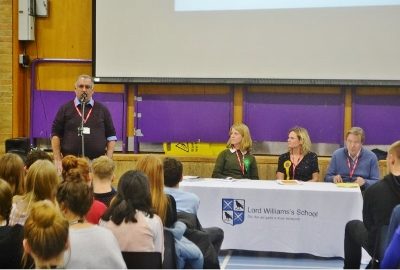
SIXTH Form students at Lord Willams’s School had the rare opportunity of listening to four political candidates for the Henley constituency giving their hustings speeches: Laura Coyle (Lib Dem), John Howell (Conservative), Zaid Marham (Labour) and Jo Robb (Green).
Over 450 students from Years 12 and 13 had the opportunity to compare and contrast party manifestos and individual approaches to key issues. The candidates were challenged to justify their positions in rigorous questioning from students studying A Level Government and Politics. Rebecca Lay, head of Government and Politics had arranged the event to coincide with the hustings event taking place later that day in Thame.
“What an excellent opportunity for students to engage with politics and their democratic rights. We were really pleased that all four candidates attended and appreciated the way they responded to our student questions. The students provided thoughtful and insightful questions and should be proud of their contributions.”
Laura Coyle for the Liberal Democrats tweeted: “The Sixth Formers gave all the candidates a good grilling and were very engaged.” Zaid Marham also tweeted “Thanks…to the…young connoisseurs of politics who made it such a great event.”
Afterwards, Jo Robb, the Green Party candidate, said: ““A great first meeting with the sixth form students at Lord Williams’s School in Thame. What an extraordinary bunch: engaged and knowledgeable. It was a pleasure meeting them.”
THE first incident that took place between 11.30pm on Monday (18/11) and 5.30am on Tuesday (19/11). Offenders attempted to gain entry to a property on Wentworth Road.
Image for illustrative purposes only
Nothing was stolen but damage was caused to the front door.
The second incident took place between 1.50am and 2am on Tuesday (19/11). Three offenders attempted to gain entry to a property on Stuart Way. Nothing was stolen.
If you live in the area please can you check any CCTV for the dates and times mentioned above.
If you have any information about this incident please report it on the Thames Valley Police website, or call 101, quoting reference 43190362967.
Find out how you can reduce the risk of becoming a victim of burglary by downloading your FREE Home Security Guide from the Thames Valley Police website HERE
THERE is some concern among Thame Town Councillors, that a capacity crisis could be looming for Lord Williams’s School, if Thame has to have more housing than has been planned for.
Questions about future planning for secondary places in the town came from Thame Town Councillors to County Councillor Nick Carter, after his quarterly report to TTC on Tuesday, November 19, included a warning that, if housing growth increases significantly more than currently planned, it could trigger the need for further expansion of education provision in Thame.
‘Future Proofing’ Lord Bill’s
Cllr Kate Gregory told Cllr Carter that she was concerned about ‘future proofing’ Lord Williams’s School and asked if there were plans for the expansion of LWS and what the plan was regarding another secondary school, and suggested it could be in Chinnor. Cllr Carter replied that Icknield School in Watlington is an alternative for Chinnor pupils, but that it does not have sixth form facilities, but that choice could be a quicker solution.
Cllr Paul Cowell said that ‘there is already pressure at Lord Williams’s’ with 13, year 7 classes. (ED. The published Admission Number for the school is 320 in each year group. However, for the academic year September 2020 – 2021 there will be an additional form of entry to Year 7, taking the admissions number for that year group to 350.) He, Cllr Cowell, feared that Thame would be left behind before the situation becomes a crisis, and asked what could be done to raise the priority for engagement between the various bodies.”
Less choice for pupils outside catchment area?
Cllr Carter said that although the county council is responsible for admissions, the fact that the school is an autonomous Academy ‘complicates relationships’. He added that LWS has a new Headteacher ‘which may well be a factor’, and that he had not spoken to him about his view yet. In his report earlier, Cllr Carter had said: “As future housing development in Thame increases the local population, the planned expansion of Lord Williams’s should ensure sufficient school choice for families within the catchment area, but there is likely to be a reduction in choice for families outside the catchment area.” (ED. As well as from Chinnor, Lord Williams’s designated area includes some Buckinghamshire villages. It also attracts children from outside its designated area, from other parts of Buckinghamshire.)
He explained that The Thame Neighbourhood Plan protects a site for a potential new primary scool, as well as for secondary school expansion. “There may be just one answer, he said, “..to build a new secondary school. But where it should be built, is a factor.”
Thame’s Primary Schools
Cllr Carter report that: “Several primary schools in the Thame & Chinnor area have expanded in response to recent and planned housing development, in some cases providing additional school capacity faster than the pupil generation from the housing growth, so in the short term creating spare places.
Once the current expansion programme is completed, there is expected to be sufficient capacity to meet demand resulting from the adopted SODC core housing strategy, but if housing growth increases significantly more than currently planned, it could trigger the need for further expansion in Thame.
Early Years Provision – not enough!
In terms of Early Years free entitlement, Cllr Carter added: “Provision across this area barely meets the needs of the local population. Additional early years capacity will be required to meet increased demand for places created by housing developments.
SOUTH Oxfordshire District Council has announced that it will be providing £88,280 to Thames Sports Club to help completely rebuild their much-used clubhouse into a modern and efficient facility for the members of the bowls club and tennis club to enjoy.
Architect’s drawing of the new Thame Sports Club’s new club house
The money comes from community contributions made by housing developers relating to new homes they’ve built nearby. This contribution is on top of an up to £250,000 community grant the council has already allocated towards the project. The plan is to demolish the old clubhouse, built in the 1920s, and build a new community building, that will have modern changing facilities, clubroom, kitchen and bar.
The whole building project will cost around £500,000 and with the rest of the funds already raised coming from other grants schemes, such as Sports England and the clubs’ own magnificent fundraising, the plans can go ahead.
Robin Bennett, Cabinet Member for Development and Regeneration at South Oxfordshire District Council, said: “It is absolutely vital that housing developers contribute to the infrastructure serving the communities near their developments. We are delighted that Thame Sports Club has been awarded this cash to go towards their fantastic new clubhouse, which will be enjoyed by existing and new residents alike.”
Peter Bozier from Thame Sports Club said: “We are thrilled and grateful to receive this money towards our much-needed clubhouse. The new building will provide improved and more modern facilities for both of our playing clubs and also the community groups who regularly use our clubhouse.”
Planning permissions have already been approved and Thame Sports Club and the old club house has already been demolished ready for buidling work to begin on the new club house.
FOLLOWING its decision not to support declaring a Climate Emergency back in June this year, as promised Thame Town Council has now adopted an Environmental Policy which, it has stated, ‘applies to all aspects of the work of Thame Town Council’.
Image courtesy of Patrick Internet
The policy goes on to state: “Thame Town Council will use its available powers and resources to protect and enhance the well-being of local people and all that comprises the natural and built world (our environment). Accordingly we will at all times seek maximum sustainability in all our dealings affecting the environment.”
On ‘Decision-making’ the policy states that the council will: “Ensure all Thame Town Council decisions take into account environmental impact and wellbeing.”
The council’s Policy and Resources committee, at its meeting on Tuesday (12/11), voted unanimously for the policy’s adoption, with minor amendments of clarification, but agreed not to include a suggested amendment to the policy to include a review of the council’s Investment strategy ‘to consider moving to investments that support ‘green technologies’ that are likely to be needed to mitigate against climate change…and to act upon that advise’.
However, it was agreed that the council will look separately at its current Investment strategy at a later date.
Cllr Sonja Francis, who originally put forward the lost motion to the council to declare a Climate Emergency, said: “Although I was very disappointed that the town council did not see fit to declare a Climate Emergency back in June, I am delighted that the town council has now produced this far reaching policy and look forward to its swift implementation. I should like to pay tribute to Cllr Helena Fickling who put in much of the work to produce an Environmental Policy that the whole committee could get behind. We all have the interests of the town at heart, and through working together, we have produced a policy that I hope, along with the Green Living Plan, show the town that the council is serious about tackling the challenges of climate change.
“I accept that asking for ‘a policy about a policy’ to include my amendment about ‘greener investments’ would be more appropriately dealt with separately, and I look forward to a robust discussion with fellow councillors and seeking professional advise on the benefits or otherwise for Thame council tax payers.”
The complete Environmental Policy reads:
1.Background/ Principles
1.1. This environmental policy applies to all aspects of the work of Thame Town Council.
1.2 .Thame Town Council will use its available powers and resources to protect and enhance the well-being of local people and all that comprises the natural and built world (our environment). Accordingly we will at all times seek maximum sustainability in all our dealings affecting the environment.
1.3. Environmental wellbeing will be considered with all other factors such as social wellbeing, public safety, prevention of crime and disorder, equality provision etc. in all that the Town Council does.
2. Commitments
Thame Town Council commits to:
2.1. Green Living Plan–Adopt a Green Living Plan for Thame (GLP)and implement it in a time frame appropriate to the challenges faced, including the review and continued development of the GLP on an ongoing basis, as required by the existing Thame Neighbourhood Plan
2.2. Decision-making –Ensure all Thame Town Council decisions take into account environmental impact and wellbeing.
2.3. Procurement–Ensure that all procurement decisions contain weightings for sustainability, consider embodied energy, eventual disposal by recycling and avoid (or, where impracticable, seek to reduce) use of any unsustainable materials.
2.4. Development / Planning–Take such action as is within our power and resources to support and encourage sustainability in all forms of development and in our planning recommendations, where appropriate seek environmental assurances beyond the requirements of relevant legislation. Town Council will expect TNP2 to have higher building standards than the existing.
2.5. Council estate and facilities–Manage our land and activities using environmentally-friendly practices that promote biodiversity and enhance habitats, in line with already documented policies and procedures.
2.6. Energy generally –Minimise energy use in all activities and buildings. Maximise the use of renewable energy and minimise waste, pollution and use of fossil fuels and other non-renewable resources. Equally sub-contractors must comply.
2.7. Climate Change, Pollution and carbon neutrality: Work with other relevant Thame based organisations, and particularly Thame Green Living and the GLP to encourage ‘Carbon Neutrality’ and reduce pollution in the air, water, the ground and from other sources within the Thame/ Moreton area by no later than such date as may be determined by the government or otherwise be practicable locally.
2.8. Biodiversity Gain is the aim!
2.9. Awareness and information–Work in conjunction with relevant partners to inform, encourage and promote environmental information across the Council and community. To train Officers and contractors to respond appropriately to feedback and utilise the process as an aid to progress and an evolving consensus.
2.10. Monitoring and reviewing–Establish and implement suitable practices and checks to monitor compliance with these objectives/ commitments and improve our environmental performance.
2.11. Resources–Make available reasonable budget and staffing resources to facilitate local environmental initiatives and support relevant volunteer community groups and local organisations furthering those initiatives.
2.12. Other authorities–Promote Thame’s environmental awareness and initiatives with the district and county councils, nearby parish councils and other official and unofficial bodies. Share best practice with (and learn from) other Town and Parish Councils and relevant national bodies. Plus follow any specific guidance issued by Central Government for Town and Parish Councils, following Central Government’s declaration of a Climate Emergency.