RESIDENTS in South Oxfordshire and the Vale of White Horse have been urged not to put batteries or other items which could cause a fire in their waste or recycling wheelie bin.
Last week two small fires started in rubbish while it was being transported in waste and recycling trucks. “Both were potentially very dangerous incidents to the crews, other road users and pedestrians”, said an SODC spokesperson. “They also caused delays to collections and could have resulted in significant damage.”
The fires were caused by items residents had put in their bins, most likely to have been standard lithium-ion batteries – like the ones found in most mobile phones.
The advise is that batteries should be put in a clear plastic bag and left on top of the green recycling bin, while small electrical items (that may also contain batteries), can be put out in a carrier bag alongside the grey refuse bin for separate collection.
ACCORDING to a report in the Oxford Mail, a warrant has been issued for the arrest of Alexis Blumenthal, who lives in Thame, and is the sister of top chef Heston Blumenthal.
Ms Blumenthal, 48, of Park Street, Thame, was set to appear at Oxford Magistrates’ Court yesterday to answer two charges of assault by beating her mother.
THE consultation period for SODC’s draft, Local Plan has been extended to 5pm on Thursday, November30, 2017. This is to provide people with the opportunity to consider the new version of the stand-alone Local Plan policies map, and the Strategic Housing and Economic Land Availability Assessment (SHELAA).
The SHELAA provides a technical assessment of the suitability, availability and achievability of land for development. It is an update to the Housing and Employment Land Availability Assessment (HELAA), which was published in March 2017. The updated document is available to view online.
All the relevant documents and the map are available HERE
SO impressed was she with her visit to the recent TAL Festival and Thame itself, that Felicia Mirza from Thame’s twin town of Sinaia, Romania, was compelled to ask Thame.Net to publish her thoughts; of course, we were delighted to oblige:
“What really counts in our world is making a beneficial change, a positive difference in people’s lives. With this in mind, I can say that Thame Arts and Literature Festival was an extraodinarily well organized event to which we, the guests from Sinaia ASPE Association were invited and given the unique chance to meet exceptional people, to take part in the various activities organized and visit the surrounding area of Thame, a place full of beauty and history. I had the feeling that the wonderful places shines every day to welcome visitors and tell everyone –who would like to listen to- their stories.
“The festival celebrated the power of words, the power of poetry, the power of historical buildings with their legends as well as their true life stories. TAL was also a celebration of literature and reading, and an opportunity to build a bridge of culture between Thame and Sinaia through Dan Manea’s presentation of Sinaia Land of the elites and his mini photo exhibition – a mirror of Sinaia landscape and historical buildings – or through the journey of ‘A quiet passion’ full of wisdom and sensibility with Emily Dickinson, one of the greatest American poets.
“I loved every minute of our visit. I loved all the stories about historical Thame as well as our trips to Waddesdon Manor, the countryside villages and Oxford ’the city of dreaming spires’.
“TAL was about celebrating friendship and communication through art so, let me take out of the 86,400 seconds we have in a day, just a few seconds to say a big THANK YOU for everything you have done for us; for your time and the kindness shown to us during our visit.”
Felicia Mirza
Member of ASPE Association-translator and guide interpreter
THOUGH they’ve worked hard to raise thousands of pounds towards building a brand new Club house that could benefit the whole community, Thame Town Cricket Club is hoping that the town council will provide some of the extra money needed to get the project started.
The project could need up to £200,000 more to be completed but with further cost savings already planned by making changes to the original specification, and further funding opportunities on the horizon, the underwriting of the project by Thame Town Council could see work begin within six weeks. Failure to do so would mean the loss of one promised funding stream with a date limit.
The hike in the estimated cost of the project, from £800,000 to up to £1.4 million, is mainly due to extra features such as a lift, a disabled toilet and additional features to make the the first floor suitable for community use, and an extra £90,000 for the foundations needed following a ‘geotech’ investigation.
Responding to concerns about any future increase in costs arising, expressed by Cllr Paul Cowell at Tuesday’s meeting of the council’s Community, Leisure and Recreation committee (CLR), Town Clerk Graham Hunt said that, although up to now the pricing had been a ‘moveable feast’, the eventual contractor would be tied to a cost, including a bit for contingencies to cover any ‘creep’.
After much discussion the CLR committee voted to recommend to the Full Council that it goes ahead and underwrites any remaining costs necessary to see the project underway.
THE police in Thame could get new powers to help tackle anti-social behaviour in response to several incidents in the town.
Following local feedback, South Oxfordshire District Council is proposing to introduce a new Public Spaces Protection Order (PSPO) which would allow police to target specific anti-social behaviour offences that occur in public areas.
The PSPO being proposed for Thame would allow police to prohibit groups of three or more from congregating, if there were concerns they were behaving anti-socially, or likely to cause alarm, distress or a nuisance in a public place. Groups causing a problem could then face fines if they failed to disperse when requested.
It is proposed by SODC that the order would apply to people aged 18+ but at a meeting of the Community, Leisure and Recreation Committee of Thame Town Council tonight (Tuesday), some councillors said that they would be petitioning for the order to apply to people aged 13+.
The order would only target anti-social behaviour and would not prevent groups from gathering together who are doing so peacefully.
The proposed new order for Thame would also continue to give the police powers to tackle alcohol related anti-social behaviour, which they currently have under the town’s Designated Public Places Order (DPPO), in place since 2009, which this new order will replace.
Under the existing Designated Public Places Order, police can take alcohol off anyone who is behaving anti-socially in a public area – if they refuse to hand the alcohol over they can be fined.
People drinking responsibly will not be affected by the proposed order which would apply to public areas and not to licensed premises.
THE people of Thame, and those involved locally in bringing together individuals ‘with a big heart’ to give aid, welcome and support to displaced people around the world, took the opportunity on Friday (October 20) to hear first-hand accounts from experts about the lives of refugees from conflicts. Their stories prompted some very searching questions for Thame’s MP about the government’s perceived lack of action to help these people, specifically children.
Members of Bread and Roses Thame and speaker guests
‘Appalling’ conditions
The evening of talks was organised by Bread and Roses Thame, and billed as Refugees: Voices from Beyond The Headlines. Five speakers with first-hand knowledge of life in refugee camps in Lebanon, Greece, Calais and Dunkirk, described movingly the backgrounds and appalling quality of life that millions of displaced people are forced to live because, as they see it, not enough is being done by the British and some other comparatively wealthy nations to offer asylum and sanctuary to more of these people, particularly unaccompanied, and therefore vulnerable children.
Why so few vulnerable, lone children brought into the UK?
Thame-based author, theologian and activist, Dr Krish Kandiah, questioned the government’s commitment to basing its help on helping only those in camps near to their own homeland and for not carrying out its obligation under the Dubs Amendment, having taken in no unaccompanied children this year. His main point was that there is value and potential in every single person. He asked why only 280 unaccompanied children had been taken in so far, why John Howell had voted against the Dubs Amendment, and what more we could do to help these kids?
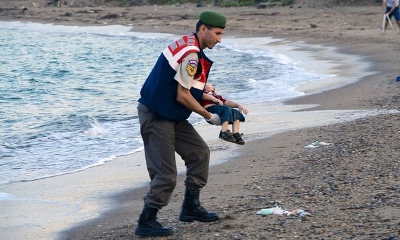
Dr Kandiah described how many of the children, particularly those who had arrived in Kent, had made their own, dangerous way and needed foster parents. He spoke of how the images on our TVs of a dead toddler washed up on a Greek shore, changed public opinion, and encouraged the government to say it would take 3,000 unaccompanied children from Europe ( a pledge later rescinded by the government in February this year after only 350 in total had been brought over since the Immigration Act had been passed).
66 Million displaced people!
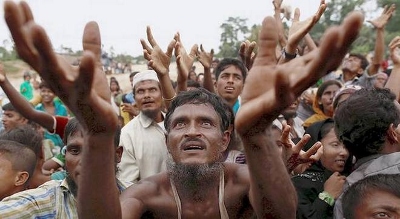
John Howell MP acknowledged that Dr Kandia had painted ‘a moving picture’ but said that he did not intend to answer his questions directly. Instead he spoke about the current global picture, including the latest crisis involving the Rohingya muslims of Burma, which were adding to the 66 million displaced people around the world, not counting economic migrants. He preferred, he said, a long-term approach where efforts are concentrated on how we can bring to an end the reasons for the displacement and helping neighbouring countries like Jordan, and helping to ensure that migrants are safe and not exploited.
Rohingya refugees (image courtesy of TheHindu.com
“We need to concentrate on the causes,” he concluded. (You can read a version of more-or-less John’s presentation, including the many facts and figures he quoted in his talk, published on his website HERE over the weekend)
In contrast, Conflict and Humanitarian Action specialist, Abeer Al-Mutawakel’s talk concentrated on the here-and-now plight of Lebanon, a very poor country, which had taken in six million refugees, the 1.5 million of which are Syrian, being 30% of the total population of Lebanon! In contrast, the UK has taken in 0.01% of its population, she pointed out.
Woman’s dead body kept in a plastic bag!
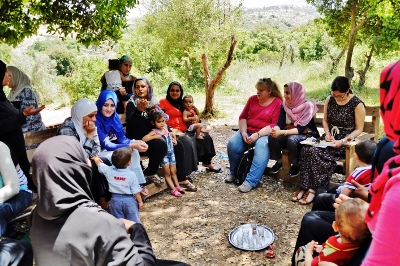
Abeer described a recent field trip she had made with Oxford Brookes University to Shheem, an informal camp for Syrians in Lebanon – a country already fragile with 450,000 Palestinian refugees before the Syrian crisis erupted. She described how the whole camp has just three toilets for the men, the struggle the men have to find work to support their families, having to take lesser jobs than the Lebanese themselves; how five to 10 people have to live in damp and smelly rooms 3 x 4 metres; how 70% ‘a lost generation’ of 800 children cannot read or write, how one woman’s dead body had to be kept in a plastic bag for three months, because her relatives could not afford the US$ 5,000 it costs to bury their dead, until someone had donated the money. Now they have bought a piece of land to bury Syrians, but they have to bury multiple bodies in one grave.
Women’s group discussion in Shheem camp, Lebanon (Image courtesy of Abeer Al-Mutawakel
Speaking of the plight of refugees, Abeer became very emotional concluding: “These people had a proper life back in their own country. They didn’t chose to leave: They were forced to leave as I was from Yemen. Please do what you can. Feel their pain.”
Founder member of Bread and Roses Thame, Sarah Weston, thanked Abeer, saying: “It is very humbling to hear the stories of these refugees. Thank you for reminding us that change can happen and that people are trying to change things.”
How many refugees come to Europe and why?
Another founder member of BRT, Helen Flitton, then introduced the next speaker, David Bailey, an A&E Staff Nurse at John Radcliffe Hospital, NHS Campaigner and member of Oxfordshire Refugee Solidarity. He pointed out that most immigrants and refugees in this country are working and contribute to our economy: “These migrants are human beings like us and need our help,” he said. He explained that 75% of refugees are internally displaced and that only 1%, come to Europe. They want to come to England, he said, because they see us as a fair and tolerant country, ‘not for the benefits!’ Those claiming asylum are only entitled to £37 per week he explained.
‘We sell the arms that cause conflicts that cause refugees’
“Around 30% of refugees are fleeing wars for which we export weapons. So we are ourselves partly responsible for their displacement,” he said.
David described his experiences of being involved with the Oxfordshire Refugee Solidarity group, taking convoys of donated goods to Calais and Dunkirk, first finding themselves banned by the French from entering and being ‘kettled’ at the French border, but since managing to make several successful trips, in one case, just a day before ‘the Jungle’ camp at Calais was demolished. He described the camp as ‘a chaotic and dangerous place’ for the 1,500 vulnerable, unaccompanied young people there. He said that the UK pays the French police 80 million euros to stop these people from coming over here, and described how they repeatedly rip down tents, burn bedding and spray tear gas over everything and pepper spray food.
Convoys of aid from Oxford to camps in France
He spoke of the vulnerability of kids to trafficking and abuse, and the growing problem of mental health problems among the refugees in these camps and asked: “Why can’t we spend that money bringing them over here? Many of them have family members in the UK they want to go to.”
He criticised those who say that ‘there is no more room in the UK for refugees. “Only 7% of the land in the UK is build on,” he said.”That leaves 93% unoccupied.”
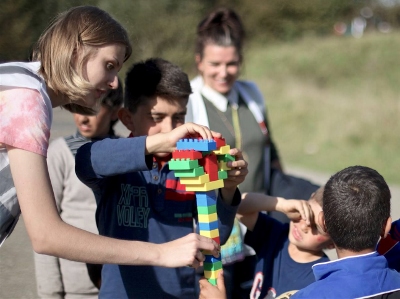
A young Oxfordshire Refugee Solidarity volunteer helps refugee children build a ‘Duplo’ tower
David described how the convoys take over toys, water-proofs, boots, paper and pens and footballs for the kids, who are not in school and have nothing to do. He concluded: “It is heartbreaking to see how the police dismantle the camps, ruin all their personal belongings and put them on buses and take them away.”
You can find out more about Oxfordshire Refugee Solidarity HERE and contact them via Facebook HERE
Abuse, torture, bereavement and mental health problems
Dr Ann Lorek, an expert in the physical, mental health and developmental needs of unaccompanied asylum-seeking children and refugees, spoke about the health needs of Refugee children. She began by speaking about the culture of Welcome in particularly Jordan, where refugees are considered to be ‘the guests of the King of Jordan’. She said that the numbers we have taken are ‘meaningless’ compared with what other countries are doing.
The reasons to leave for these people are many she explained. Some of them for instance, may have been child soldiers who face mental health risks from their experiences. The closure of European routes, she said, had led to more people taking dangerous sea crossings, with 51% of those from Libya for instance reporting trauma en route, which would have been beatings, torture, death of family members, sexual abuse etc. “The impact of their experiences,” she explained, “resulting in nightmares, self-harm, anger-management problems and more.”
Dr Lorek spoke about how important it is for the children to have normal activities like school etc, and how there are Child Protection issues around bullying, FGM of girls – a third of the girls reported having been raped. She spoke about how the Red Cross and Red Crescent organisations were trying to find lost families to reunite the children with. She concluded with a quote from a refugee:
“Once you become a refugee, your life is never complete. There’s always a part of your life missing.”
The Flying Seagull
The final speaker at the Bread and Roses Thame event, which was held at John Hampden School in Thame, was Beckie Briley, representing The Flying Seagull Project, which, in their own words, takes ‘love, light and laughter’ to refugee camps as well as hospitals, orphanages, marginalised communities and slums around the world through games, arts, music, craft, clowns and circus shows. They work closely with local organisations to pinpoint need and tailor their work accordingly.
Beckie explained how, for kids with trauma, using their imaginations and play is very important, and how bereavement can be expressed through play. Speaking about Flying Seagull’s recent United in Laughter project in Greece, where she witnessed the water and the food being turned off and the local police tear-gasing the refugees, she said: “The camp there was horrific.”
Nevertheless, she recalled ‘the energy of 12,000 kids and the joy on their faces at the magic show the group put on for them. At times, Beckie said she found the tension that was often palpable amongst the children, melt away once their trust had been gained.
Questions and Answers
During the Q and A session that followed, John Howell MP was asked about the value of, and asked to share his personal views about, the UK Arms Trade. He admitted that he had no idea of the value of the British Arms Trade, adding: “It is difficult to answer what the impact of the arms trade is.” Referring to the war in Yemen, he said that there was a need to stop the rebels who are supported by the Iranian military. He was asked why the UK was not delivering on the needs of these desperate people when we have ‘the supply side’, people longing to be matched with the need, and able to deliver. Why are they being stopped?
The MP replied that, whilst he had heard ‘the fantastic work being done by ordinary people’, it was his view that it was better for the government to work on stopping refugee crises happening in the first place, tackling, what he called ‘the crisis of governance around the world‘ and to do what it could to rebuild communities. He said that he was ‘putting pressure on the government to make sure schemes were working’, and that he could see ‘no reason why they (asylum seekers) should not be able to join their families’.
Dr Kandiah said that ‘we should take our fair share of refugees, and if we did, we would be setting an example to other countries like the Saudis who take none.”
David Bailey then told John Howell: “Fighter jets have been sold to Turkey to use against the Kurds, causing refugees; cluster bombs sold to the Yemen. I care about what my government does in my name. It cannot be beyond us, the sixth most richest nation in the world, to do more.” He then asked the MP why he was against the Dubs Agreement.
John Howell replied that he wanted to protect kids. He then, in passing, mentioned the group of children that had been taken in by Oxford, adding: “And we all know about the sexual abuse and child protection issues that Oxford has had recently!” – A remark felt to be ‘inappropriate’ by at least one audience member.
Dr Ann Lorek told the audience that there are children in Greece who have been given approval but have not been allowed to come here.
Name just one thing we should all do!
All the speakers were asked to say, if there was just one thing they could advise members of the audience to do to help refugees, or one thing they would like to see happen, what would it be?
David Bailey said: “Go and see for yourself! Our organisation will take you along on one of our convoy visits for around just £50.” He recommended that people look at the website ‘Are you Syrious’ LINK HERE
Abeer Al-Mutawakel said that her one thing, would be for child marriage to stop; (during her visit to the camp in Shheem she was struck by the pregnancy rate among young women. Most young women in that camp were pregnant and had babies and toddlers at the same time which gave her concern for the opportunities for the coming generation).
John Howell asked that everyone present join him in spreading the word to the doubters that the 0.7% of UK GDP spent on foreign aid, IS worth it.
Dr Krish Kandiah told the audience: “Open your eyes as if YOU were in that situation and think what YOU would like someone to do for you.”
THAMES Valley Police is appealing for witnesses following a theft from a vehicle in Thame.
At 10.30am this morning (23/10) two unknown offenders (males) smashed the rear window of a Citroen on Hampden Avenue, Thame and took a STHIL disc cutter. The offenders then drove off in a blue Ford Focus.
If you have seen any suspicious looking people or vehicles in these areas or have any information relating to this message please call the Police via the 24 hour non-emergency telephone number 101.
Alternatively, if you have information but wish to remain anonymous, please call Crimestoppers on 0800 555 111 or online by visiting www.crimestoppers-org.uk. No personal details are taken, information is not traced or recorded and you will not go to court.
THE consultation period for SODC’s draft, Local Plan has been extended to 5pm on Thursday, November30, 2017. This is to provide people with the opportunity to consider a new version of the stand-alone Local Plan policies map, and the Strategic Housing and Economic Land Availability Assessment (SHELAA).
The SHELAA provides a technical assessment of the suitability, availability and achievability of land for development. It is an update to the Housing and Employment Land Availability Assessment (HELAA), which was published in March 2017. The updated document is available to view online.
All the relevant documents and the map are available HERE
THE Cards For Good Causes charity Christmas card shop will again be opening this year in Thame.
The shop will be open for the 12th year in Christchurch, Upper High Street, Thame, and will be officially opened by the Mayor, Tom Wyse, on Friday November 10.
Opening hours will be Monday-Saturday 10am to 4pm – closing on Friday, December 8.
There will be cards and gifts from at least 25 national and local charities who will receive a minimum of 70p in the pound from their sales.