THE Oxfordshire EAG (Expressway Action Group) reports that it has been told informally that the National Infrastructure Commission (NIC) Final Report with its recommendations for the Oxford to Cambridge Expressway route(s) will be published before the autumn budget on November 22.
On November 28, Highways England will begin its Stage 1a “consultations” on alternative routes which they call ‘corridors’ with an MPs group and with “Strategic Stakeholders” from December 4, to end in February 2018. The EAG says this means they will have to reveal what the alternative routes are before beginning their engagement with Stakeholders. Highways England has confirmed that it intends to announce its decision on the final route/corridor by July 2018. However, no public consultation is proposed by them on the alternative routes, or by the NIC on the principle of the Growth Corridor.
‘200,000 new houses for Oxfordshire’
Commenting Peter Rutt, Co-ordinator of the Oxfordshire Expressway Action Group said: “Unfortunately, it is safe to assume that the NIC will endorse the OxCam Growth Corridor concept, with its one million new homes. This could mean nearly 200,000 more houses in Oxfordshire alone. I suspect very few people in Oxfordshire realise that this means they are planning to nearly double Oxfordshire’s total housing by positioning this new Expressway motorway as a ‘growth corridor’.
“This approach would require a similar doubling of schools, surgeries, hospitals, roads and town centres. This is not sustainable, and it is all being planned behind closed doors. How can such a vast change to our countryside be proposed without asking Oxfordshire if it agrees? Why are there no plans for a full Public Inquiry? Consultations after the fact are just box-ticking exercises.”
District Councillor gives her support to the action group
South Oxfordshire District Councillor, Elizabeth Gillespie said: “Upgrading the A34 and the current roads to Cambridge seems the only rational route for a new Expressway, if one is justified at all. It is hard to see what case could be made to go through the Green Belt and countryside of South Oxfordshire instead, with all the environmental damage that would inevitable cause. I fully support the aims of the Expressway Action Group in opposing any such route.”
The original NIC report in November 2016 recognised that the Green Belts around Oxford (and Cambridge) are a development constraint. However, as both cities are attractive economic targets, the Green Belt may not mean less development into the County, just that it will be highly concentrated on the non-designated areas.
Chancellor to relax Green Belt constraints ?
Peter Rutt explained: “Given Philip Hammond has hinted at relaxing Green Belt constraints in his Budget, and is expected to endorse the NIC findings, it is reasonable to fear these two issues are linked, so the Oxford Green Belt may not be as secure as we would all hope. Whatever the route of the Expressway, the Growth Corridor will be a transformative change, and not in a nice way, for all of largely rural Oxfordshire. The least harmful option would be upgrading the A34 while the greatest harm would be done if a route through the countryside South of Oxford was selected. It will reduce our open countryside, harm most people’s amenity and cause permanent damage to the environment and wildlife. There is no Oxfordshire need for it as we already have a prosperous economy and full employment, they are trying to make us to sacrifice our great rural assets for nothing.”
Implications for Oxfordshire
The NIC state in their earlier official Report that the Corridor project would mean one million more homes and could create up to 700,000 new jobs. EAG estimates that this means an average of 10,000 houses and 7,000 new jobs per mile. As the Expressway through Oxfordshire would be at least twenty miles on the Expressway’s Southern route and nearly thirty on the Northern, that would mean 200,000 – 300,000 new houses, and bringing new people here to live in them – all this in a County which already statistically has more than full employment.
At the last census Oxfordshire’s existing housing stock was 270,000. Assuming it’s now 290,000 the EAG calculate that the Growth Corridor aims to increase Oxfordshire’s housing stock by 70% to 100%, and would increase Oxford’s current working age population of around 500,000 people by up to 40% in just a few years. Oxford currently has full employment – so if new jobs were created they would have to be filled by people and their dependents from elsewhere in the UK.
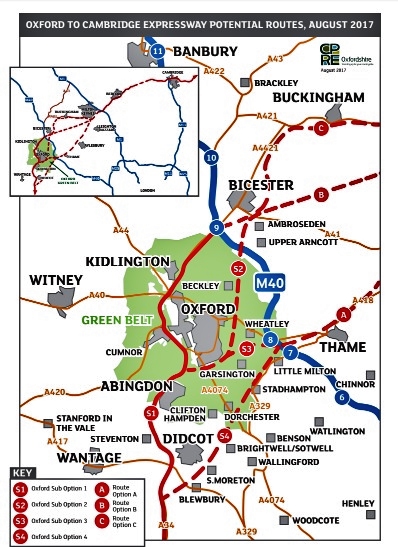
** (Ed. One of the options, Option A, would see a new carriageway branch off the A34 and pass between the Oxfod and Abingdon, before crossing the M40 at Wheatley and proceeding north of Aylesbury to Milton Keynes.)
** Thame Town Councillors are waiting to learn which route is announced before deciding whether or not to join the Expressway Action Group, and to see if there are any implications for Thame. (Route A will pass to the North of Thame – see map)
SOURCE: Contributed by Expressway Action Group (AEG)