** The text in italics below was omitted from the original report. PLANS for 37 new homes on land at The Elms, just off the High Street, Thame, which have been been the subject of much criticism, suspicion and bad feeling, including attracting over 2,000 signatures to a petition against it, have been passed by South Oxfordshire District Council.
Despite objections from English Heritage and SODC’s Conservation Officer, and objections to the plan from Thame Town Council, the planning committee felt that the benefits offered by the development, including improvements to the neighbouring park, the quality of the build, new public open space and the 40% affordable housing provision, outweighed any possible detrimental impact from the development.
In a statement to Thame.Net, the applicant, Simon Vickers, welcomed the decision. He said: “We are very pleased that the SODC planning committee affirmed the view of their officers and acknowledged the tremendous amount of thought that had gone into the scheme. They also praised the extremely high quality design. They further acknowledged that there will be substantial benefits to the town in terms of a major new park, improvements to the existing park and new homes that will be built in the most sustainable of locations. With the extremely upsetting and unwarranted personal attacks by a few people, it is gratifying that our approach has been completely vindicated. We now look forward to continuing to work constructively with the Town on the implementation of something that we truly believe will be a scheme to be proud of.”
But others have reacted with less enthusiasm. Speaking after the decision, Thame resident, Adrian Reynolds, who spoke against the application, said: “We were told that by voting ‘Yes’ in the Neighbourhood Plan referendum, ‘this site will be developed whether you say ‘Yes’ or ‘No’, and ‘if you vote ‘No’ you will have more development forced upon you’. That was what was stated in all the campaign literature. What people voted for, was to have more say. You have just run rough-shod over Thame, over the 75% who voted to have more say over development.
“I cannot express how disappointed the majority of Thame is over your decision today.”
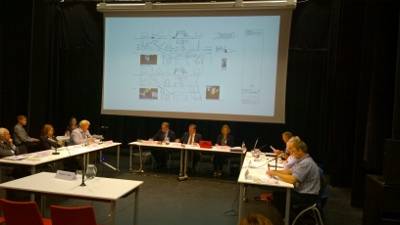
Before the committee reached its decision, four votes to two however, a lot was said from both sides at the planning committee meeting on Wednesday, July 22. Four people spoke against the proposed development, including two Thame Town Councillors, and a group of three people spoke for the applicant, Rectory Homes.
Thame Town Council’s objections
Referring to this ‘very controversial application’, Cllr Mary Stiles told the committee that many people in Thame, incuding some town councillors, were opposed to any development on this site, and that the town council was objecting to this particular plan because it did not comply with the Thame Neighbourhood Plan, nor was it supported by SODC’s Conversation Officer or English Heritage. The four reasons for TTC’s objection were, she said, overdevelopment of the site, traffic generation, harm to the Conservation Area and insufficient affordable housing.
Cllr Stiles went on to explain that in the town council’s view, over development was in three ways: The crescent part of the application was contrary to Policy HA4 of the Thame Neighbourhood Plan, which restricts residential development to the eastern and south eastern side of the site. Half of the crescent is too the south and south west; the crescent is also too close to the listed building, harming its setting; most of the dwellings are three storey buildings, again contrary to Policy HA4, which restricts the height to two or 2.5 storeys.
On traffic generation she said TTC was concerned about this, both during construction and after the dwellings are occupied, in that increased traffic movements, in particular those generated by construction vehicles, would have an adverse effect on local residents. Nelson Street, Cllr Stiles said, was due to be made one way (South to North) because of current traffic and parking issues, and Rooks Lane is already one way North to South, and is very narrow, as is Southern Road.
“We are very concerned about the level of harm to the Conservation Area,” she said, “if this application is recommended for approval, when both SODC’s Conservation Officer and English Heritage are opposed. The Conservation Officer’s view that in order to comply with HA4 of the Thame Neighbourhood Plan and the 1990 Planning Act re Listed Buildings and Conservation Areas, the development would need to be significantly reduced to no more than a few houses in a parkland setting (with the shortfall accommodated elsewhere – which is already in the Neighbourhood Plan, if fewer than 45 houses are built on this site) and English Heritage’s view is that the harm this application causes to the listed building would only be justified if the proposals delivered a very high level of public benefit, which could not be obtained by other means.
“Providing public access to the rear of the Elms does not need this development – a simple footpath would suffice.”
Thame Town Council’s view was, Cllr stiles went on, that the target 40% for affordable housing should be achieved within the development itself through actual affordable units. “Thame councillors know that people need houses, but developments must not cause harm to the Conservation area. I urge you to refuse this application,” she concluded.
In responding to a question from Cllr Joan Bland, Cllr Stiles said that there was ‘plenty of scope’ in the Neighbourhood plan to provide the 37 houses in this plan, else where in Thame.
Next to speak was Adrian Reynolds, a resident of Thame for 24 years, and Dr Paul Winsom who was speaking for the Elms Petition Group which has lobbied against development at The Elms, and to have the site removed from the Thame Neighbourhood Plan. Mr Reynolds told the planning committee that the purpose of his objection was: “..to safeguard Thame’s Character as a Market Town.” He continued:
The inclusion of The Elms in the Thame Neighbourhood Plan is questioned
“The thrust of the TNP Referendum YES campaign was that voting ‘yes’ for the TNP would give Thame a greater say in its future, it would then be cheating everyone who voted ‘yes’ in that referendum to ignore the wishes of Thame Town Council and Thame’s residents. Furthermore it would be entirely wrong to interpret the ‘yes’ result as meaning the people of Thame want the Elms developed. A very large number of Thame residents have signed the petition against the Elms and have lodged their objections on thame.net and in the Thame Gazzette, while there has not been a single supporter outside of the developer.
“The inclusion of the Elms within the TNP is linked with Lord Williams Lower School which confuses the issue of exactly when this site would be needed or drawn upon. The late Inclusion of the Elms was also the most unpopular inclusion of any of the sites with Thame residents who overwhelmingly stated they did not want it in the plan. In addition the inclusion has the spectre of ‘Conflict of Interest’ hanging over its inclusion as ruled by the Royal Town Planning Institute and this only serves to bring doubt to the integrity of any decision to develop the site.

‘Uncertainty in the town’
“There are several large changes to our Market town that have already been agreed by planning, but whose impact is far from being understood. Principally: The Cattle Market is moving out of the town, the move has been agreed but no plans have yet been agreed for the use of this site adding even more uncertainty; the industrial development at Howland Road, which itself breached the TNP illustrating that it is not in fact sacrosanct; building of the remaining 775 new homes on more publicly supported and sustainable sites.
“All these changes are bringing huge uncertainty to our town. We are now here considering compounding this by destroying the Elms Conservation Area which is an important and defining feature of the town, as recognised in the Thame Conservation Area Character Appraisal. The development of The Elms represents no sizeable benefit to the town but represents a hugely increased risk to the town’s character and its history as a Market Town.
“One unforeseen impact of the decisions already made seems to be the difficulty of letting existing industrial units within the town. This has already led to a public consultation to develop the brown field site at Goodsons Mews to provide over 30 homes near the town centre. If approved this would negate the need to develop a Conservation Area. Surely developing a Brown Field site is preferable to developing a green field site (I say this even though Goodsons Mews would have a far greater impact on my own home than the Elms would).”
Mr Reynolds concluded: “If this development does become necessary to meet future requirements then the conservation area will still be there to be destroyed. But to grant permission for the Elms BEFORE the impact of any of the planning decisions already made is known, is not planning but chaos and puts our Town at completely unnecessary risk and it is very difficult to understand why this would be done.
‘Don’t ignore the wishes of Thame’
“With the controversy and unpopularity surrounding the inclusion of the Elms in the development plan NOW is definitely not the time to decide to destroy this key feature of our Town.
“I understand that Simon Vickers purchased the Elms as a family home so I am sure that there is no urgency on his part to develop either and thus no livelihood will be placed at risk by refusing this permission. I Ask you not to look at this application in isolation nor to ignore or misinterpret the wishes of the people of Thame and, not to ignore the wishes of Thame Town Council. I also ask you: Not to ignore the concerns of English Heritage; not to ignore the concerns of your own Conservation officer; not to ignore you own advice of 2006 as contained in Thame Conservation Area Character Appraisal and hence to Refuse this planning application for the good of Thame.”
‘Major flaws in the application’
Dr Paul Winson then spoke on behalf of The Elms Petition Group, the members of which, he said were concerned that there were ‘major flaws’ in the application.
Firstly, he said: The building designs, layout and massings contravened the Thame Neighbourhood Plan because they are three storey buildings and the plan allows for a maximum of 2.5 storeys. The actual designs of the buildings he said:”… bear no resemblance to any other dwellings in Thame and therefore appear particularly alien in this setting.”
Dr Winson said that The Elms was brought into the Conservation Area in 2006 by SODC, specifically to protect it from unnecessary and unsympathetic development. “This proposal makes a mockery of the whole concept of conservation as this proposal irrevocably changes the look and feel of this greenfield site and of course the adjoining park,” he said. “The Neighbourhood Plan seeks to enhance the Conservation Area – not destroy it.”
Dr Winson then referred the access to the site through a proposed new entrance from Elms Road that will be fed by Southern Road, Nelson Street, Rookes Lane and ultimately the High Street. “This road system is struggling to cope with the existing level of traffic,” he said, “let alone the extra traffic generated both during and after construction. A heavily used pedestrian thoroughfare including large volumes of children and the elderly, will become more dangerous.”
He concluded by asking that the plan be refused to allow the houses to be reallocated to a more sustainable development location around Thame.
Affordable houses and improvements to the park
Speaking on behalf of the applicant Rectory Homes, Jolande Bowater, of Barton Willmore, told the committee that the plans for The Elms complied with both SODC’s own Core Strategy and the basic conditions of the Thame Neighbour Plan, and that no challenge had been made to the adopted plan. “There have been extensive discussions and consultations over these plans,” she said, “and your Officers have concluded that permission should be granted.” She told the committee that four years’ work had gone into the plans and that there had been engagement at all stages since 2013.
They had, she said, improved the lay-out as requested and also made changes to the proposed improvements to Elms Park.
Ms Bowater confirmed that there would be 40%, that’s 14 affordable homes provided. Answering the concerns about the height of some of the homes, she said that their height did not go against the Neighbourhood plan and that they would be no higher than nearby houses. She added that the scheme would mean the minimal loss of trees and that a payment of £300,000 would be made to the town council for improvements at Elms Park itself, improvements that would be decided through public consultation to be carried out by Thame Town Council.
Any harm to the site of the housing development itself would be ‘less than substantial’ she said.
Planning Committee member, Cllr David Turner, asked Ms Bowater why the row of houses on the Park Street boundary end of the plans could not have been moved further south to reduce the impact on the existing properties, to which she replied that they could not because of a large Oak tree in the way and that it was felt better to maintain a wide space at the point where the site is accessed by the public from the park next door.
‘Serious reservations’ about the development
The next speaker was Cllr David Dodds, who is a District Councillor as well as being a town councillor. He told the committee that when The Elms element of the plan was consulted on (Ed. the Draft of the Neighbourhood Plan), out of 39 responses only seven were in favour of the site being included. He said that in all the references made to the relevance of the Neighbourhood Plan, the officer omitted ESDQ 15 and ESDQ 20. (Ed. 15 says: ” Developers must demonstrate in a Design and Access Statement how their proposed development reinforces Thame’s character.” 20 says: ” Building Style must be appropriate to the historic context.”) and that he hoped the committee had ‘seriously read, very carefully’ what English Heritage said and what SODC’s own Conservation Officer had said. “There are, and will remain very serious reservations about development on this site.”
Cllr Dodds too expressed his concerns about ‘the nightmare’ of increased traffic in the surrounding streets, particularly mentioning the ‘tricky’ junction at the Southern Road end of Windmill Road.
He concluded: “The town council, who are the holders of the Neighbourhood Plan, voted against this application. They have full knowledge. Please take notice of that.”
75% voted for the Neighbourhood Plan
Planning Committee Member, Cllr David Turner, asked Cllr Dodds how many people voted in the Neighbourhood Plan referendum, to which he was told 2,900, 75% of whom voted ‘Yes’.
The Planning Officer in the case, Emily Hamerton, in her summing up, said that Historic England (formerly English Heritage) and the Conservation Officer’s evidence ‘were only concerned about historic issues’. The plans, she said included affordable homes, were sustainable, the site had been allocated in the Neighbourhood Plan and was of a contemporary design. She recommended that it be approved.
‘The harm is outweighed by the benefit’
Cllr Margaret Turner, Ward member for Didcot West, proposed Approval of the application and she was seconded by Cllr Anthony Dearlove, Ward member for Didcot South. Cllr Margaret Turner said: “The application complies with our policies and the harm is outweighed by the benefit.”
Cllr Joan Bland, Ward member for Henley-on-Thames, said: “I have heard what has been said. If we approve this application, we would have lost a major lung in the heart of Thame and it will never be replaced. My conscience will not allow me to agree to this. This site should never have been in the plan (Ed. TNP), which states that it could be built on but not that it should be, and it could be saved for our heritage.”
Cllr Richard Pullen, Ward member for Benson and Crowmarsh said: “This development will enhance the area and benefit the community.”
Cllr Toby Newman, Ward member for Wheatley Parish, said: “This is a tough one – a lot of people are against this plan and there are strong feelings but from my perspective, (the development) is well designed. I am also conscious that this area of land has been closed off and without this development would remain private and not seen by the public. I also recognise that it has been allocated in the Neighbourhood Plan which was voted in by 75% of those who voted.”
Cllr Dearlove said that he thought it was ‘a well thought out plan’, and that the site would be opened to the public and so ‘the benefit would out-weight any thing else.’ Cllr Margaret Turner added: “I can understand people’s anxiety. The view will change. But this is a fantastic location and the trees will soften the views. It is an allocated site and well designed, and a lot of work has gone into a good, sustainable site.
“I just hope that when it is finished, the people of Thame will see the benefit.”
The Planning committee then voted 4 votes to 2, to pass the application.


Leave a Reply